Direct Payment Now Live via OCPI with Payter & CCV

EVesto Direct payment

Direct Payment Now Live via OCPI with Payter & CCV, Seamless Transactions for CPOs

At EVesto, we’re dedicated to enabling frictionless experiences for Charge Point Operators (CPOs). Today, we’re excited to announce that Direct Payment is now live via OCPI for charging sessions using Payter and CCV, giving EVesto customers modern flexibility and convenience at the point of charge.

Building on our ongoing partnership with CCV, aimed at simplifying and future-proofing open payments for CPOs, this new capability empowers operators to accept instant payments directly at the charge point, without redirecting drivers to apps or QR screens.

EVesto Direct payment
Key Benefits for CPOs:

✔︎ Seamless direct payment acceptance via OCPI
✔︎ Integrated with the EVesto customer portal for simplified setup and management
✔︎ Drivers can pay on the spot with familiar Payter & CCV terminals
✔︎ Fully compliant and scalable for public charging environments

How It Works

CPOs using EVesto can now connect direct payment terminals via OCPI. Once activated, drivers can simply tap or pay at the station, speeding up transactions and improving user satisfaction, all while centralizing data and reconciliation in the EVesto portal.

As always, we handle the technical integration, all you need to do is reach out to us so we can activate the feature inside the portal. Prefer support in onboarding? Just reach out!

Interested in Direct Payment for your charging network?

Contact us to learn more or to enable this feature for your site.

Let’s accelerate smarter, easier charging, together.


Why AI in EV charging only works when companies work together

Electric vehicles charging at modern EV charging stations on a shared platform, with a digital data network above symbolizing AI-driven operations and collaboration in EV charging infrastructure.

Why AI in EV charging only works when companies work together

The EV charging industry is entering a decisive new phase.
After years of rapid rollout, pilots and expansion, the focus is shifting toward reliability, operational excellence and scalable growth.

For Charge Point Operators (CPOs), success is no longer defined by the number of charging points deployed, but by how predictable, efficient and resilient their operations have become.

One conclusion is becoming increasingly clear across the industry:
no single company can solve this challenge alone.

That is why EVesto and Evailable are working together. Not to add another tool to the stack, but to show how AI-driven operations and strong platform foundations must come together to make EV charging truly future-proof.

Electric vehicles charging at multiple EV charging stations in an urban environment, with a subtle digital network above representing AI-driven monitoring and real availability across the charging network.
The EV market is growing up

EV charging has moved beyond its introduction and consolidation phases. The market is now firmly in its growth phase:

  • Networks are expanding internationally
  • Service Level Agreements are becoming stricter
  • Uptime and availability are business-critical, not optional

From a driver’s perspective, charging should be simple: plug in and charge, every time. From an operator’s perspective, however, reality is far more complex. Larger networks mean more data, more dependencies, more incidents and higher operational pressure.

In this phase, one principle stands out:

Charging has to become boring.
Not boring in innovation, but boring in reliability.

Uptime is not availability

Many CPOs still manage their networks based on uptime metrics. But a charger being “online” does not guarantee a successful charging session.

Common issues include:

  • Chargers that appear available but fail during sessions
  • Hardware delivering reduced power without triggering errors
  • Problems that only become visible once customers complain

Industry data shows that a significant share of charging sessions still fail, even when infrastructure appears operational. In many cases, customers notice problems before operators do.

The underlying issue is structural:
most CPMS platforms are designed for administration and configuration, not for deep operational diagnostics, prediction and prioritisation.

AI as an operations layer, not a feature

This is where AI plays a crucial role, but only if applied correctly.

AI should not be treated as a dashboard add-on or innovation showcase. Its real value lies in acting as an operations layer, continuously analysing behaviour across the network and supporting daily decision-making.

Evailable was built precisely with this goal in mind. Its AI capabilities:

  • predict failures before they cause downtime
  • look beyond error codes by learning normal behaviour per charger
  • identify patterns across hardware types, locations and usage
  • automate recovery actions where possible

The result is fewer incidents, lower operational effort and, most importantly, more successful charging sessions.

But AI alone is not enough.

Why collaboration is essential

AI only delivers real value when:

  • data quality is high and consistent
  • operational processes are clearly structured
  • integrations reduce complexity instead of adding to it

This is where EVesto comes in.

EVesto provides CPOs with a robust operational and commercial foundation:

  • CPMS functionality
  • contract and tariff management
  • settlement, reporting and scalable processes

Within this foundation, Evailable acts as an intelligent extension:
an AI-driven layer focused on real availability, not just system status — without requiring CPOs to replace their existing CPMS.

Through EVesto-enabled API integration:

  • OCPP data is securely shared
  • consent and governance are ensured
  • AI insights become actionable within daily operations

The result is not a collection of disconnected tools, but one coherent operational ecosystem in which platforms and AI reinforce each other.

What this means for CPOs
The combined EVesto × Evailable approach enables CPOs to:
  • Increase availability structurally
    By acting on predictive insights instead of reacting to incidents.
  • Reduce operational costs
    Fewer manual investigations, fewer truck rolls, fewer escalations.
  • Scale without scaling headcount
    AI automates analysis and recovery, while EVesto provides operational clarity.
  • Make better decisions based on real performance
    Not just charger status, but actual charging success and customer experience.
  • Prepare for stricter SLAs and regulation
    Reliability becomes measurable, explainable and controllable.
Building a mature EV charging ecosystem together

The future of EV charging does not lie in isolated innovations or standalone tools. It lies in ecosystems, where specialised partners collaborate and each focuses on what they do best.

EVesto and Evailable share this vision. By combining CPMS expertise with AI-driven operational intelligence, we help CPOs not just to grow, but to grow sustainably and confidently.

Because in the end, EV charging does not need to be exciting.
It needs to be reliable, predictable and always available.

Why open standards like OCPP and OCPI are essential for the future of EV charging infrastructure

Digital illustration of a glowing neural network shaped like a brain, symbolizing the connection between OCPP and OCPI in a futuristic EV charging ecosystem

Why open standards like OCPP and OCPI are essential for the future of EV charging infrastructure

In the rapidly evolving world of electric mobility, interoperability is no longer a luxury, it’s a necessity. Open standards such as the Open Charge Point Protocol (OCPP) and the Open Charge Point Interface (OCPI) play a crucial role by enabling standardized communication between various systems and stakeholders within the EV ecosystem.

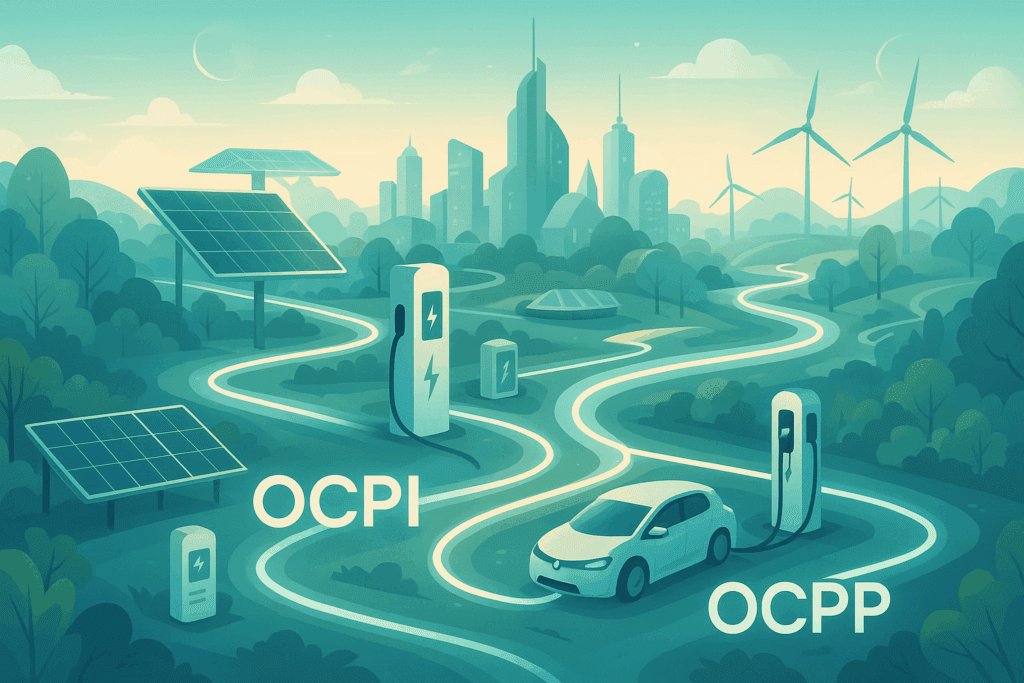
Futuristic landscape illustration of a smart city powered by solar panels, EVs, and wind turbines, with glowing paths labeled OCPI and OCPP representing energy and data flow.
The Power of Open Standards

Open standards offer numerous benefits for both operators and end-users:

  • Flexibility: Charging stations from different manufacturers can be easily integrated, reducing dependence on a single vendor.
  • Future-Proofing: Standardized communication protocols allow for updates and upgrades without the need for complete system replacements.
  • Cost Savings: Reduced reliance on specific vendors leads to more competitive pricing and lower operational costs.
OCPP: The Backbone of Charging Station Communication

OCPP is designed to provide a uniform method of communication between charging stations and central systems, regardless of the manufacturer. The latest version, OCPP 2.0.1, makes it anable to introduce advanced features such as:

  • Plug & Charge (ISO 15118): Enables automatic authentication and payment as soon as an EV is connected, eliminating the need for cards or apps.
  • Enhanced Security: Built-in security protocols protect against cyber threats.
  • Device Management: Simplifies the installation, configuration, and maintenance of charging stations, including support for remote firmware updates.
  • User Interface: Supports multilingual displays and provides real-time information to users, enhancing accessibility and user-friendliness.

These new features not only improve the user experience but also simplify operations and increase efficiency for charging network operators.

OCPI: Seamless Roaming and Data Exchange

OCPI facilitates data exchange between e-Mobility Service Providers (eMSPs) and Charge Point Operators (CPOs), granting EV drivers access to a wide network of charging stations. The recent version, OCPI 2.3.0, introduces:

  • EU AFIR Compliance: Meets the requirements for data exchange with national access points.
  • Extensibility: Offers possibilities for custom extensions, allowing market participants to implement specific functionalities that align with their business models.
  • Direct Payment Module: Enables direct payments without the involvement of an eMSP.
  • These enhancements lead to a better charging experience for both operators and users.
EVesto’s Commitment to Open Standards

At EVesto, we strongly believe in the power of open standards. Therefore:

  • We fully support OCPP 1.6 and largely support 2.0.1, ensuring our customers benefit from the latest functionalities.
  • We are prepared for the implementation of OCPI 2.3, enabling seamless roaming and data exchange.
  • We actively share our knowledge and experience within the industry to promote the adoption of open standards.

By building on open standards, we ensure our customers are not tied to outdated technology and are always ready for the future.

The Future of EV Charging Infrastructure

The adoption of open standards like OCPP and OCPI is essential for the continued growth and development of EV charging infrastructure. They provide the flexibility and scalability needed to meet the increasing demand for electric mobility.

Curious about how EVesto can future-proof your charging infrastructure? We are happy to inform you about the possibilities through a clear demo.


Key Protocols that govern Electric vehicle (EV) charging

Key Protocols that govern Electric vehicle (EV) charging

Protocols are crucial for effective communication in the electric vehicle (EV) charging ecosystem. They ensure interoperability, standardization, and secure communication between various components. This article explores the significance of protocols and how EVesto utilizes them to deliver seamless and efficient charging solutions.

The Importance of Protocols in EV Charging

Protocols play a vital role in the operation of EVs and their charging infrastructure. They enable interoperability, ensuring effective communication between devices, systems, and networks. Protocols also provide a framework for standardization, guaranteeing compatibility between EVs, charging stations, and management systems from various manufacturers. Additionally, they define the implementation of functions and features, such as remote control and firmware updates.

Moreover, protocols incorporate security features to protect against unauthorized access and malicious attacks, ensuring the integrity of the charging process and user data. They also enhance the user experience by enabling roaming services and simplifying EV charging.

Here are some of the most important ones:

  1. Open Charge Point Protocol (OCPP): This is a universal protocol for communication between charging stations and a central management system. It allows for remote control, firmware updates, session information, and more. There are several versions of OCPP, with 2.0.1 being the latest.
  2. IEC 61851 is an international standard for electric vehicle conductive charging systems. It defines the communication between the EV and the charging station for AC charging.
  3. ISO 15118: This international standard defines the communication between the EV and the charging station. It supports advanced features like Plug and Charge (PnC) and bi-directional charging (V2G).
  4. CHAdeMO: This is a DC charging standard that was developed in Japan. It supports both fast charging and bi-directional charging.
  5. Combined Charging System (CCS): This is a standard for DC fast charging developed by several major automobile manufacturers. It combines the AC and DC fast charging connectors into a single port on the vehicle.
  6. Tesla Supercharger: This is a proprietary DC fast charging protocol developed by Tesla. It is currently only compatible with Tesla vehicles.
  7. Open Charge Point Interface (OCPI): This protocol allows roaming services between different charging station networks. It enables EV drivers to use charging stations from different operators with a single subscription.
  8. OpenADR (Automated Demand Response): This is a standard for communication between utilities and customers to adjust power demand. It can be used in EV charging to shift charging times to periods of low electricity demand.
  9. The Open InterCharge Protocol (OICP): is a protocol developed by Hubject, a joint venture of several major companies, including BMW, Bosch, Daimler, and others. It was created to facilitate the interoperability of charging infrastructure and services for electric vehicles (EVs).OICP is primarily used in Europe and allows for the exchange of information between different charging station operators and e-mobility service providers.
  10. The eMobility Interoperation Protocol (eMIP): is an open protocol developed by GIREVE. It enables the transfer of data and services between an operator’s software platform and GIREVE’s platform. The protocol aims to enable roaming of charging services and provide access to a comprehensive charging point database.
  11. The Open Smart Charging Protocol (OSCP): is an open standard for communication between EV charging stations, management systems, and smart grid components, enabling smart charging, demand response, and grid integration.
  12. The Open Clearing House Protocol (OCHP): is an open standard for EV charging networks. It enables seamless roaming and billing between different charging operators. OCHP allows EV drivers to access stations from multiple operators using a single authentication and payment method.
  13. SAE J3400 Standard: This is a significant new development, representing a milestone for Tesla-developed connectors used in EV charging. The SAE J3400 standard marks a step towards defining the design, construction, and technical characteristics of the connectors and inlets used in EV charging. It aims to expand charging access for current and future EV drivers by moving the North American Charging Standard (NACS) connector towards an open industry standard. This initiative is expected to enhance interoperability and streamline the charging experience for EV drivers.
  14. NACS – North American Charging Standard: Introduced by Tesla and now adopted as NACS, this standard offers AC and DC charging capabilities in a single plug, with capacities exceeding those of the CCS standard. Major automakers, including Ford and General Motors, have announced plans to adopt NACS, indicating its significant impact on the industry. Vehicles compatible with NACS are anticipated to start rolling out in 2025, with adapters available for use in the meantime.

Protocols and standards specific to Europe for electric vehicle (EV) charging
There are a few other protocols specific to Europe that are next to the above-mentioned protocols.

  • IEC 62196: This is an international standard, but it’s particularly relevant in Europe. It defines the physical connectors used in EV charging. Type 2 connectors, specified in this standard, are the most common connectors used for EV charging in Europe.
  • IEC 61851-1: This standard is used worldwide but is very important in Europe. It defines the conductive charging system between the electric vehicle supply equipment (EVSE) and the EV, including the control functions and digital communication.
  • IEC 61851-23, -24: These standards define DC charging and the digital communication between the EV and the EVSE for DC charging.
  • EN 50604: This European standard defines safety requirements for exchangeable lithium batteries in light EVs.
  • EN 50498: This European standard applies to devices installed in EVs intended for driver interaction. It includes requirements for the user interface of EV charging stations.
  • European Directive 2014/94/EU: This directive sets out the minimum requirements for deploying alternative fuel infrastructure across Europe, including EV charging stations. It promotes the use of common standards and interoperability to facilitate the growth of EV charging infrastructure.

EVesto Leveraging Protocols for an Enhanced Charging Experience
EVesto recognizes the significance of protocols in delivering an enhanced charging experience. The platform’s core foundation is built around standard protocols such as Open Charge Point Protocol (OCPP), Open Charge Point Interface (OCPI), and Open InterCharge Protocol (OICP).

EVesto’s connectivity layer, powered by OCPP, establishes seamless communication between chargers and EVesto’s central management system. This enables remote control, firmware updates, and session information, ensuring efficient charging processes. Additionally, EVesto’s Charge Point Management System (CPMS) supports ISO 15118, allowing advanced features like Plug and Charge (PnC).

The platform also leverages OICP to facilitate interoperability and information exchange with other charging infrastructure providers, enhancing the availability and accessibility of charging stations.

Protocols are essential in the EV charging ecosystem, ensuring compatibility, standardization, and secure communication. EVesto understands the importance of protocols and utilizes them to deliver an enhanced charging experience. By implementing industry-standard protocols such as OCPP, ISO 15118, and OICP, EVesto enables effective communication, advanced features, and interoperability. As the EV industry evolves, protocols will continue to drive innovation and shape the future of electric vehicle charging.