Direct Payment Now Live via OCPI with Payter & CCV

EVesto Direct payment

Direct Payment Now Live via OCPI with Payter & CCV, Seamless Transactions for CPOs

At EVesto, we’re dedicated to enabling frictionless experiences for Charge Point Operators (CPOs). Today, we’re excited to announce that Direct Payment is now live via OCPI for charging sessions using Payter and CCV, giving EVesto customers modern flexibility and convenience at the point of charge.

Building on our ongoing partnership with CCV, aimed at simplifying and future-proofing open payments for CPOs, this new capability empowers operators to accept instant payments directly at the charge point, without redirecting drivers to apps or QR screens.

EVesto Direct payment
Key Benefits for CPOs:

✔︎ Seamless direct payment acceptance via OCPI
✔︎ Integrated with the EVesto customer portal for simplified setup and management
✔︎ Drivers can pay on the spot with familiar Payter & CCV terminals
✔︎ Fully compliant and scalable for public charging environments

How It Works

CPOs using EVesto can now connect direct payment terminals via OCPI. Once activated, drivers can simply tap or pay at the station, speeding up transactions and improving user satisfaction, all while centralizing data and reconciliation in the EVesto portal.

As always, we handle the technical integration, all you need to do is reach out to us so we can activate the feature inside the portal. Prefer support in onboarding? Just reach out!

Interested in Direct Payment for your charging network?

Contact us to learn more or to enable this feature for your site.

Let’s accelerate smarter, easier charging, together.


Why AI in EV charging only works when companies work together

Electric vehicles charging at modern EV charging stations on a shared platform, with a digital data network above symbolizing AI-driven operations and collaboration in EV charging infrastructure.

Why AI in EV charging only works when companies work together

The EV charging industry is entering a decisive new phase.
After years of rapid rollout, pilots and expansion, the focus is shifting toward reliability, operational excellence and scalable growth.

For Charge Point Operators (CPOs), success is no longer defined by the number of charging points deployed, but by how predictable, efficient and resilient their operations have become.

One conclusion is becoming increasingly clear across the industry:
no single company can solve this challenge alone.

That is why EVesto and Evailable are working together. Not to add another tool to the stack, but to show how AI-driven operations and strong platform foundations must come together to make EV charging truly future-proof.

Electric vehicles charging at multiple EV charging stations in an urban environment, with a subtle digital network above representing AI-driven monitoring and real availability across the charging network.
The EV market is growing up

EV charging has moved beyond its introduction and consolidation phases. The market is now firmly in its growth phase:

  • Networks are expanding internationally
  • Service Level Agreements are becoming stricter
  • Uptime and availability are business-critical, not optional

From a driver’s perspective, charging should be simple: plug in and charge, every time. From an operator’s perspective, however, reality is far more complex. Larger networks mean more data, more dependencies, more incidents and higher operational pressure.

In this phase, one principle stands out:

Charging has to become boring.
Not boring in innovation, but boring in reliability.

Uptime is not availability

Many CPOs still manage their networks based on uptime metrics. But a charger being “online” does not guarantee a successful charging session.

Common issues include:

  • Chargers that appear available but fail during sessions
  • Hardware delivering reduced power without triggering errors
  • Problems that only become visible once customers complain

Industry data shows that a significant share of charging sessions still fail, even when infrastructure appears operational. In many cases, customers notice problems before operators do.

The underlying issue is structural:
most CPMS platforms are designed for administration and configuration, not for deep operational diagnostics, prediction and prioritisation.

AI as an operations layer, not a feature

This is where AI plays a crucial role, but only if applied correctly.

AI should not be treated as a dashboard add-on or innovation showcase. Its real value lies in acting as an operations layer, continuously analysing behaviour across the network and supporting daily decision-making.

Evailable was built precisely with this goal in mind. Its AI capabilities:

  • predict failures before they cause downtime
  • look beyond error codes by learning normal behaviour per charger
  • identify patterns across hardware types, locations and usage
  • automate recovery actions where possible

The result is fewer incidents, lower operational effort and, most importantly, more successful charging sessions.

But AI alone is not enough.

Why collaboration is essential

AI only delivers real value when:

  • data quality is high and consistent
  • operational processes are clearly structured
  • integrations reduce complexity instead of adding to it

This is where EVesto comes in.

EVesto provides CPOs with a robust operational and commercial foundation:

  • CPMS functionality
  • contract and tariff management
  • settlement, reporting and scalable processes

Within this foundation, Evailable acts as an intelligent extension:
an AI-driven layer focused on real availability, not just system status — without requiring CPOs to replace their existing CPMS.

Through EVesto-enabled API integration:

  • OCPP data is securely shared
  • consent and governance are ensured
  • AI insights become actionable within daily operations

The result is not a collection of disconnected tools, but one coherent operational ecosystem in which platforms and AI reinforce each other.

What this means for CPOs
The combined EVesto × Evailable approach enables CPOs to:
  • Increase availability structurally
    By acting on predictive insights instead of reacting to incidents.
  • Reduce operational costs
    Fewer manual investigations, fewer truck rolls, fewer escalations.
  • Scale without scaling headcount
    AI automates analysis and recovery, while EVesto provides operational clarity.
  • Make better decisions based on real performance
    Not just charger status, but actual charging success and customer experience.
  • Prepare for stricter SLAs and regulation
    Reliability becomes measurable, explainable and controllable.
Building a mature EV charging ecosystem together

The future of EV charging does not lie in isolated innovations or standalone tools. It lies in ecosystems, where specialised partners collaborate and each focuses on what they do best.

EVesto and Evailable share this vision. By combining CPMS expertise with AI-driven operational intelligence, we help CPOs not just to grow, but to grow sustainably and confidently.

Because in the end, EV charging does not need to be exciting.
It needs to be reliable, predictable and always available.

EVesto expands into Germany with a partnership with GLS Mobility

Two business hands shaking, one emerging from a laptop and the other from a payment terminal, symbolizing the partnership between EVesto and GLS Mobility.

EVesto expands into Germany with a partnership with GLS Mobility

EVesto is proud to announce a new strategic partnership with GLS Mobility GmbH, a leading provider of EV charging payment and billing solutions. This collaboration strengthens our technology stack while expanding our presence in the German market.

Who is GLS Mobility?

GLS Mobility (founded as part of the GLS Bank Group) develops cloud-based payment and billing systems designed for e-mobility infrastructure. Their core products include the recently rebranded bill.bo platform (with LITE, SMART, and PRO modules) for transaction processing and invoicing, and the Pay-t terminal that supports card, NFC, and girocard payments. GLS Mobility is already active in Germany and Switzerland and is expanding into the Benelux region.

In 2025, GLS Mobility also announced a roaming partnership with Gireve to enable direct payments at charging stations within the European ecosystem, without requiring operators to replace existing hardware.

What this means for EVesto customers

By combining EVesto’s CPMS with GLS Mobility’s payment expertise, we deliver a single, integrated platform experience for Charge Point Operators.

Key benefits for CPOs include:
One integrated platform – Manage tariffs, monitoring, and backend operations within EVesto, with bill.bo payment and billing seamlessly embedded.

Compliant, future-proof payments – Direct card, NFC, and girocard payments aligned with European regulations such as AFIR and LSV.

Modular & scalable – Choose from different bill.bo packages (LITE, SMART, PRO) depending on your operational maturity and ambitions.

Lower implementation costs – Hardware-agnostic solutions mean operators don’t need to replace their charging stations.

Interoperability & roaming – Thanks to roaming connections like Gireve, networks gain wider reach and flexibility.

Better driver experience – Familiar payment methods and transparent billing ensure smoother charging journeys.

Strategic impact

Expanding into Germany

With our first German colleague on board and a trusted partner like GLS Mobility, EVesto now has a strong local foundation to grow in the DACH region.

Bringing payments & CPMS together

Where payment technology is often a separate layer, EVesto will integrate it directly into the CPMS, delivering one complete platform for operators.

Customer-driven innovation

Whether small-scale operators or large networks, the modular setup enables faster adoption and growth, while keeping the driver at the center.

Availability

The integration of bill.bo Mobility functionality into the EVesto platform will be activated in phases. Existing customers can contact their account manager for more details about enabling GLS Mobility payments. New customers will be guided during onboarding to select the right bundle and configuration.

Together with GLS Mobility, EVesto is building a charging ecosystem where complexity is invisible and charging simply works.

We invite all interested CPOs to sign up for a demo of our updated platform and experience first-hand how EVesto can simplify your operations and enhance your market reach.

Why open standards like OCPP and OCPI are essential for the future of EV charging infrastructure

Digital illustration of a glowing neural network shaped like a brain, symbolizing the connection between OCPP and OCPI in a futuristic EV charging ecosystem

Why open standards like OCPP and OCPI are essential for the future of EV charging infrastructure

In the rapidly evolving world of electric mobility, interoperability is no longer a luxury, it’s a necessity. Open standards such as the Open Charge Point Protocol (OCPP) and the Open Charge Point Interface (OCPI) play a crucial role by enabling standardized communication between various systems and stakeholders within the EV ecosystem.

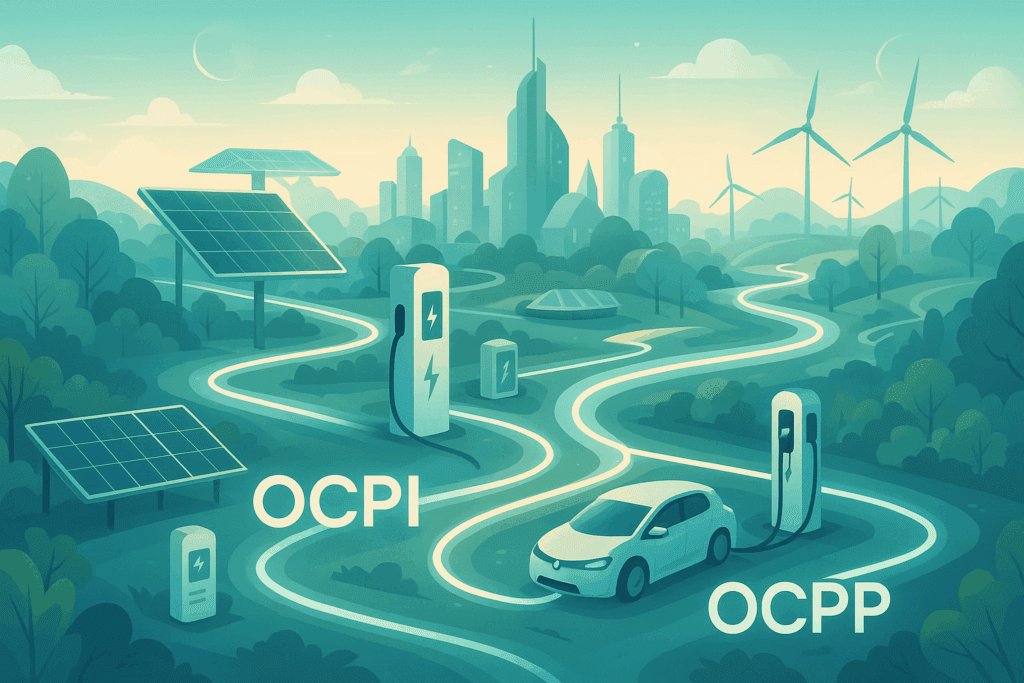
Futuristic landscape illustration of a smart city powered by solar panels, EVs, and wind turbines, with glowing paths labeled OCPI and OCPP representing energy and data flow.
The Power of Open Standards

Open standards offer numerous benefits for both operators and end-users:

  • Flexibility: Charging stations from different manufacturers can be easily integrated, reducing dependence on a single vendor.
  • Future-Proofing: Standardized communication protocols allow for updates and upgrades without the need for complete system replacements.
  • Cost Savings: Reduced reliance on specific vendors leads to more competitive pricing and lower operational costs.
OCPP: The Backbone of Charging Station Communication

OCPP is designed to provide a uniform method of communication between charging stations and central systems, regardless of the manufacturer. The latest version, OCPP 2.0.1, makes it anable to introduce advanced features such as:

  • Plug & Charge (ISO 15118): Enables automatic authentication and payment as soon as an EV is connected, eliminating the need for cards or apps.
  • Enhanced Security: Built-in security protocols protect against cyber threats.
  • Device Management: Simplifies the installation, configuration, and maintenance of charging stations, including support for remote firmware updates.
  • User Interface: Supports multilingual displays and provides real-time information to users, enhancing accessibility and user-friendliness.

These new features not only improve the user experience but also simplify operations and increase efficiency for charging network operators.

OCPI: Seamless Roaming and Data Exchange

OCPI facilitates data exchange between e-Mobility Service Providers (eMSPs) and Charge Point Operators (CPOs), granting EV drivers access to a wide network of charging stations. The recent version, OCPI 2.3.0, introduces:

  • EU AFIR Compliance: Meets the requirements for data exchange with national access points.
  • Extensibility: Offers possibilities for custom extensions, allowing market participants to implement specific functionalities that align with their business models.
  • Direct Payment Module: Enables direct payments without the involvement of an eMSP.
  • These enhancements lead to a better charging experience for both operators and users.
EVesto’s Commitment to Open Standards

At EVesto, we strongly believe in the power of open standards. Therefore:

  • We fully support OCPP 1.6 and largely support 2.0.1, ensuring our customers benefit from the latest functionalities.
  • We are prepared for the implementation of OCPI 2.3, enabling seamless roaming and data exchange.
  • We actively share our knowledge and experience within the industry to promote the adoption of open standards.

By building on open standards, we ensure our customers are not tied to outdated technology and are always ready for the future.

The Future of EV Charging Infrastructure

The adoption of open standards like OCPP and OCPI is essential for the continued growth and development of EV charging infrastructure. They provide the flexibility and scalability needed to meet the increasing demand for electric mobility.

Curious about how EVesto can future-proof your charging infrastructure? We are happy to inform you about the possibilities through a clear demo.


Choosing the Best CPMS: 10 Questions to Ask Before Choosing Your CPMS

Choosing the Best CPMS: 10 Questions to Ask Before Choosing Your CPMS

In the rapidly evolving world of electric vehicles (EVs), having efficient Charge Point Management Software (CPMS) is no longer a luxury—it’s a necessity. But with so many options available, how do you choose the best CPMS for your needs? In this guide, we’ll explore the essential questions to ask and the benefits of EV charging management software.

What is Charge Point Management Software (CPMS)?

At its core, CPMS is a digital platform designed to manage and monitor EV charging stations. It ensures that charge points are operational, users can access them seamlessly, and charge point operators (CPOs) can gather data and insights from their charging infrastructure. CPMS ensures that EV charging stations are effectively managed, monitored, and maintained.

What is CSMS in EV Charging?

CSMS stands for Charging Station Management System. It’s another term often used interchangeably with CPMS. Both refer to systems that manage and monitor EV charging stations, ensuring optimal performance and user experience.

What is an Electric Vehicle Management System?

An Electric Vehicle Management System (EVMS) is a broader term encompassing all systems managing various aspects of electric vehicles, from battery management to charging infrastructure. CPMS is a subset of EVMS, focusing specifically on the charging infrastructure. EVMS is a critical component of modern electric vehicles. It ensures the vehicle operates efficiently, safely, and reliably, providing drivers with a seamless and enhanced driving experience. As EV technology continues to evolve, the functionalities and capabilities of EVMS are expected to expand further, making it even more integral to the EV ecosystem.

Benefits of EV Charge Point Management Software

  • Efficiency: Streamlines operations, ensuring chargers are always available and operational. CPMS provides a centralized platform to manage multiple charging stations, regardless of their geographical location. This allows charge point operators (CPOs) to monitor each charging point’s status, availability, and performance from a single dashboard.
  • User Experience: For EV drivers, a well-managed charging infrastructure means less waiting time, transparent billing, and a seamless charging experience. And for CPOs, this means a higher EV driver retention rate. CPMS plays a pivotal role in ensuring all of this.
  • Data Analytics: Offers insights into usage patterns, peak demand times, and other valuable metrics. This data can be used to make informed decisions about expanding or optimizing the charging infrastructure for CPOs.
  • Cost Savings: Predictive maintenance can lead to a more efficient allocation of maintenance resources and better planning, ensuring that chargers remain operational for the maximum possible time. A better user experience can increase customer loyalty, reducing the costs of acquiring new customers.
  • Dynamic Pricing: CPMS allows CPOs to set dynamic pricing models based on various factors such as demand, time of day, energy prices, and special events. By adjusting prices in real-time, CPOs can optimize revenue and manage costs more effectively.
  • Scalability: As the number of EVs and charging stations grows, CPMS provides the scalability to manage this expanding infrastructure without compromising efficiency or user experience.
  • Real-time Monitoring: One of the key features of CPMS is its ability to monitor charging stations in real-time. This includes tracking the status of each charging point, identifying any faults or issues, and ensuring that stations are operating optimally.
  • Maintenance and Troubleshooting: CPMS can send alerts and notifications in case of any malfunction or required maintenance. This helps reduce downtime and ensures that charging stations are always available.
  • Integration with Other Systems: CPMS can often be integrated with other systems, such as payment gateways, customer relationship management (CRM) software, ERP systems, and financial systems to support invoicing and energy management systems. This provides a holistic approach to managing the entire EV charging ecosystem.


Key Questions to Ask When Choosing a CPMS for Your Operations

  • Compatibility:
  • Why it matters: Different EV charging stations might operate on various standards and protocols. Your CPMS should be versatile enough to handle them all.
  • Deep Dive: Does the software support both AC and DC charging standards? Can it integrate with newer charging technologies as they emerge?
  • Is the team and the product versatile enough to adapt to market changes in protocols and standards?
  • Scalability:
  • Why it matters: As the demand for EVs grows, so will the need for more charge points. Your CPMS should grow with you.
  • Deep Dive: Can the software efficiently manage a few chargers today and scale to handle hundreds or even thousands in the future without significant upgrades or costs? Can it operate on a global scale in different regions and continents?
  • Features and Functionality:
  • Why it matters: A CPMS should do more than just manage charge points. It should offer insights, analytics, and real-time data to optimize operations.
  • Deep Dive: Does the software provide detailed usage statistics? Can this data be used to grow my business efficiently? Can it alert you to issues or maintenance needs before they become critical? Can it adapt to new technological advancements in the market?
  • User Experience:
  • Why it matters: An intuitive interface ensures operators can easily navigate and utilize the system. It should be simple enough for anyone to understand.
  • Deep Dive: Is the operator dashboard easy to navigate and understand? Are there white labelling options
  • Integration Capabilities:
  • Why it matters: A good CPMS should seamlessly integrate with other systems, from billing to energy management to an ERP system.
  • Deep Dive: Does it offer APIs for easy integration with other platforms? Can it work in tandem with renewable energy sources or grid management systems?
  • Roaming Capabilities:
  • Why it matters: Roaming capabilities allow customers to use their membership at your charging stations to charge their vehicles at other network stations. This feature can significantly enhance the user experience and your network’s accessibility.
  • Deep dive: Is the CPMS integrated with major roaming partners across Europe and the rest of the world?
  • Cost Considerations:
  • Why it matters: Affordability is key, but it’s essential to understand the full cost spectrum.
  • Deep Dive: Beyond the initial purchase or subscription price, are there costs associated with updates, additional features, or scaling up? Are there hidden commissions and other fees involved?
  • Security Features:
  • Why it matters: With increasing cyber threats, ensuring the security of user data and payment information is paramount.
  • Deep Dive: Does the software undergo regular security audits? Are payment gateways encrypted and compliant with industry standards?
  • Uptime and Reliability:
  • Why it matters: Downtime can lead to lost revenue and customer trust. A reliable CPMS ensures continuous availability.
  • Deep Dive: How does the provider handle outages? Is there a backup system in place? Are there any guarantees or SLAs related to uptime? What is the uptime of the CPMS?
  • Support and Maintenance:
  • Why it matters: Regular updates and prompt customer support ensure your CPMS remains at the forefront of technology and efficiency.
  • Deep Dive: What kind of customer support is available? Is it 24/7? How frequently are software updates rolled out, and are they automatic?


Key Features of EVesto:

  • Low Cost: EVesto offers two different models, Connect and Roaming.
  • Connect: Price per connector, per month € 1
  • Roaming: Price for roaming per connector per month: € 1.25. EVesto has a minimum fee of €400 monthly to cover running costs and support. Additional features that we add in the future might incur additional costs, but they will always be related to the number of connectors.
  • No Commission: EVesto believes in collective growth with customers without transaction fees.
  • Plug & Play: EVesto’s approach enables immediate online charger connection on their platform.
  • Independent Strategy: EVesto is fully independent, partnering with customers to define the platform’s future.
  • Quick Time to Market: EVesto offers a fast onboarding process with chargers online within minutes.
  • Roaming: EVesto integrates with all major roaming platforms, making it easy for CPOs to connect with the roaming hub of their choice or to set up direct connections with the eMobility Providers, enabling CPOs to link with multiple charging networks and establish bilateral agreements with EMPs.
  • Unlimited Scaling: EVesto is designed for exponential growth without disturbances.
  • Plug & Charge: EVesto is ISO 15118 certified, supporting CPO and OEM for a hassle-free charging experience.
  • Self-Service Portal: EVesto’s self-service portal offers a comprehensive platform that seamlessly supports all operator processes. Everything can be efficiently managed and configured within the portal, from operations, sessions, and users to CDRs, roaming, and white-label options.
  • Customer service with EVA Global: EVesto collaborates with EV Assist, offering a 24/7 omnichannel service backed by EVA Global’s expert technical support team. This team is dedicated to addressing customer challenges at the charge point and beyond, currently serving end-users across 32 countries in 30 languages, with continued expansion.
  • Security: EVesto, adhering to the ‘security by design’ principle, emphasizes the integration of security best practices throughout the development and operational phases of EV chargers. A cornerstone of their security strategy is the implementation of ‘rotating secrets.’ When an EV charger is integrated into the EVesto platform, it’s provisioned with two secrets, Secret A and Secret B. Using the OCPP security profile 2, the EVesto portal provisions a new secret via the ChangeConfiguration command, followed by a reset. This allows for the rotation of Secret A, bolstering the charger’s security.
  • Uptime: EVesto, a leading player in the EV industry, stands at the forefront by boasting an unprecedented uptime of over 99.9%.

Choosing the best CPMS is crucial for anyone offering efficient and reliable EV charging services. By asking the right questions and understanding the benefits and functionalities of these systems, you can ensure you’re making an informed decision.

Integrating Webfleet with EVesto enhances EV adoption in fleets, giving managers a unified view of assets. Webfleet remains the main hub for fleet managers, while EVesto handles charger operations seamlessly
Riccardo Becker
CMO of EVesto

Optimizing EV Charging Costs with Dynamic Pricing

Cut Expenses & Boost Sustainability

The introduction of dynamic pricing is set to transform the electric vehicle charging landscape. EVesto is at the forefront of this innovation, leveraging strategic tools to sync charging activities with real-time energy rates. This blog delves into how dynamic pricing can dramatically transform the EV charging landscape, offering significant advantages to Charge Point Operators (CPOs) and EV drivers.

Understanding Dynamic Pricing for EVs
Dynamic pricing for EVs enables users to adjust charging costs based on the hourly fluctuations in energy prices. Using predictive data that forecasts energy costs 24 hours in advance, EVesto empowers smart charging strategies that optimize cost and energy usage during the cheapest and least congested times.

The Technical Backbone of Dynamic Pricing
Dynamic pricing for EV charging might sound complex. Still, it essentially boils down to a smart system that adjusts the price of EV charging based on when electricity is cheapest and most plentiful. Here’s how it works, step by step:

1. Real-Time Energy Rates:
In dynamic pricing for EV charging, we utilize a “day-ahead” pricing model, where electricity costs for each hour of the next day are known in advance, sourced from the ENTSO-E Transparency Platform. This system enables EV charging to be planned during cheaper times, typically at night or when renewable energy production is high. By automatically adjusting charging rates based on these forecasts, dynamic pricing ensures users benefit from lower costs and supports increased use of renewable energy, all without requiring manual monitoring.

2. Predictive Algorithms:

  • These are like weather forecasts but for electricity prices. They use past data to predict when electricity will be cheap or expensive in the next 24 hours.
  • For example, you might decide to picnic when it’s sunny, but this system determines the best time to charge EVs when electricity prices are low.

3. Integration with EV Chargers:

  • Dynamic pricing is communicated to EV charging stations through an automated system. Here’s a streamlined overview:
  • Dynamic Tariff Notification: We inform all Mobility Service Providers (MSPs) via the Open Charge Point Interface (OCPI) daily about the next day’s hourly tariffs. This ensures everyone is prepared for the changes in charging costs.
  • Charging Session Calculation: Our system calculates the cost of each charging session using the provided tariff data. Charge Point Operators (CPOs) can adjust prices by adding a markup or setting a minimum price to ensure profitability.
  • Automated Scheduling: While we don’t currently offer scheduling capabilities, the system to do this must be an EMS or some other intelligent system or MSP solution like Deftpower. Nevertheless, our system optimizes EV charging for the lowest electricity prices. This process is fully automated, requiring no EV driver intervention.

4. Smart Charging:

Automated Charging Control: We ensure that tariffs are effectively communicated to MSPs or other relevant parties via the OCPI. This empowers MSPs to remotely initiate or terminate charging sessions based on the tariff data received. While OCPI facilitates such control actions irrespective of the tariff type, MSPs can utilize the tariff information to make informed decisions on when to commence or cease charging sessions, a functionality that aligns with the principles of smart charging. Energy Management Systems (EMS) may also leverage this tariff data for similar purposes.

  • Optimized Charging: Our system ensures that your car charges when electricity is cleanest and cheapest, aligning with the principles of smart charging. This automated process not only saves you money but also contributes to a greener planet by minimizing the carbon footprint associated with charging.
  • User Interface: CPOs can configure dynamic tariffs, set them on chargers or groups of chargers using batch operations, and review the type of tariff applicable during each session or Charge Detail Record (CDR). While managing the charging schedule is typically the task of MSPs, every CPO can access their own data. Thus, in the future, CPOs may be able to examine how a session looks and how pricing is compiled based on dynamic prices. The dashboard empowers CPOs with valuable information while leaving the control of scheduling and session management to the relevant parties.
  • Economic Benefits of Dynamic Pricing
  • Dynamic pricing provides more than just reduced electricity costs. For CPOs utilizing EVesto’s platform, it optimizes infrastructure utilization by incentivizing charging during off-peak periods, thereby balancing the load on the grid. It translates into direct savings for EV drivers, making EV ownership more economically attractive.

Dynamic Pricing Implementation at EVesto
EVesto is actively developing dynamic pricing capabilities through its advanced API technology. Ongoing development of OCPI code aims to broaden the accessibility and functionality of this feature.

The Shift Towards Flexible Charging: Dynamic vs. Static
Unlike static charging, where fees are fixed regardless of the time or energy demand, dynamic charging adjusts fees based on actual usage and grid conditions. This flexibility is key to managing energy flows more effectively, especially as the number of EVs on the road grows.

With its pioneering approach to dynamic pricing, EVesto is charting a path toward a future where electric mobility thrives economically and environmentally. This innovative strategy boosts cost efficiencies and enhances grid harmony by incentivizing charging during off-peak hours. As the electric vehicle industry evolves, adopting technologies like dynamic pricing is becoming essential. These advancements are pivotal in reaching broader energy management goals and ensuring the economic sustainability of EV charging infrastructures.

EVesto Launches the Most Accurate Dynamic Pricing Model for EV Charging

EVesto Partners with Webfleet

Today, EVesto announces the launch of its innovative Dynamic Pricing feature, setting a new standard for accuracy and flexibility in EV charging. Powered by Entso-E, Europe’s leading source of electricity market data, Dynamic Pricing empowers Charge Point Operators (CPOs) to align their tariffs with actual, up-to-date electricity costs, ensuring every charging session is fair and transparent

Dynamic Pricing Key Benefits

  • Accurate, Actual Pricing: EVesto uses Entso-E’s data to update tariffs based on actual electricity costs, building customer trust with market-aligned pricing.
  • Revenue Control: Fixed Margins ensure CPOs maintain profitability, while Min/Max tariffs stabilize rates, even during volatile times.
  • Eco-Friendly Charging: By encouraging charging during renewable energy availability, Dynamic Pricing appeals to eco-conscious EV drivers.

In a recent study, 23% of Dutch EV drivers reported high satisfaction with dynamic pricing, and 31% are considering the switch. EVesto’s new feature responds to this demand, positioning it as the most accurate, customer-focused actual pricing model on the market.


Download the Dynamic Pricing Brochure to learn more: Download Here

The CPO Dilemma: Tackling challnges in the charging frontier

The CPO Dilemma: Tackling challnges in the charging frontier

Charge Point Operators (CPOs) are vital in advancing the Electric Vehicle (EV) infrastructure. However, this journey is loaded with challenges that require innovative solutions. The road to a successful CPO can be intricate, from fragmented charging infrastructure to financial hurdles and operational efficiency. Here, we delineate common challenges CPOs face and spotlight how EVesto’s platform is designed to alleviate these hurdles, paving the way for a thriving EV charging business.

1. Infrastructure Costs:
Establishing a charging station involves significant capital expenditure. The costs include charging equipment, electrical infrastructure, permits, and potentially constructing a suitable location.

2. Lack of Standardization:
The lack of standardization in charging technology, connectors, and communication protocols can create compatibility issues between different EVs and charging stations, hindering a seamless charging experience.

3. Operational Efficiency:
Efficiently managing charging station operations, including maintenance, repairs, and updates, is challenging. Ensuring charging stations are operational and available when needed is crucial for customer satisfaction.

4. Energy Supply and Demand Management:
Managing the energy supply to meet demand, especially during peak times, is complex. This also includes dealing with the impact of EV charging on the local electricity grid.

5. Pricing Strategies:
Developing a pricing strategy that covers the costs of operations and infrastructure while remaining competitive and attractive to EV drivers can be challenging.

6. Regulatory Compliance:
Navigating through the regulatory landscape, which may vary significantly from region to region, can be a significant challenge. Compliance with local laws, standards, and regulations is crucial for successful operations.

7. Consumer Awareness and Adoption:
Promoting awareness and encouraging the adoption of EVs and EV charging services among consumers is essential for growing the customer base and achieving a good return on investment.

8. Cybersecurity:
As charging stations become more advanced and connected, ensuring cybersecurity to protect against data breaches and other cyber threats is imperative.

9. Real-time Monitoring and Management:
Implementing systems for real-time monitoring and management of charging stations to ensure optimal performance and address issues promptly.

10. Interoperability:
Achieving interoperability with other charging networks and systems is important for providing a seamless user experience, especially for roaming services across different operators and regions.

11. Site Acquisition and Permitting:
Acquiring suitable sites for charging stations and navigating through the permitting process can be time-consuming and challenging

12. Technology Advancements:
Keeping up with rapid EV and charging technology advancements ensures the charging infrastructure remains relevant and up-to-date.
At EVesto, we recognize the multifaceted challenges CPOs encounter. While it’s an arduous task to eliminate all these challenges, we are committed to easing the journey wherever possible. Our Charge Management Platform System (CMPS) is designed as a sturdy stepping stone that CPOs can rely on as they traverse through the demanding terrain of EV charging. Our CMPS is not just a solution; it’s a dependable companion.

Here’s how EVesto stands as a supportive ally to CPOs:

1. Operational Excellence:
Operational efficiency is crucial for customer satisfaction. EVesto’s platform is engineered for real-time monitoring and management, ensuring charging stations are operational and available when needed. Next to this,EVesto boosts an unprecedented uptime of over 99.9% . By setting remarkable standards for uptime and promoting transparency through real-time updates and independent verification, EVesto differentiates itself in the technology landscape.

2. Cost Efficiency:
Initial setup costs form a significant part of the investment for CPOs. Our platform is priced competitively, ensuring affordability without compromising on quality.

3. Accelerated Onboarding:
A fast onboarding process reduces time to market significantly, addressing the operational efficiency challenge.

4. Seamless Roaming Integrations:
Expanding the charging network’s reach through integrations with multiple roaming hubs opens new revenue streams.

5. Unlimited Scaling:
EVesto’s platform is crafted for exponential growth, aligning with the scalability requirement of the evolving EV landscape.

6. Scalability
As the demand for EV charging grows, the ability to scale operations is imperative. EVesto’s platform facilitates seamless scaling, aiding CPOs in expanding their services in alignment with market growth.

7. Cybersecurity:
By embedding security best practices from the get-go, EVesto ensures a robust defence against cyber threats, which is pivotal as charging stations become more connected. This proactive approach can help CPOs significantly mitigate the risks associated with data breaches and other cyber threats, thus addressing the cybersecurity challenge.

8. Energy Supply and Demand Management:
Collaborations with partners like Ampcontrol offer CPOs access to additional smart charging and energy management solutions, helping them lower energy costs, ensure reliable charging, and better manage the energy demand of their charging stations.

9. Integration with Multiple Roaming Hubs:
By integrating with multiple roaming hubs and enabling quick setup of peer-to-peer connections with e-Mobility Service Providers (EMPs), Evesto facilitates the expansion of the charging network’s reach. This expansion is crucial for enabling seamless roaming services, opening up new revenue streams, and providing a seamless user experience, especially for roaming services across different operators and regions.

10. Interoperability:
EVesto’s platform provides interoperability between different charging networks and systems by adopting open standards and API integrations, which are foundational for achieving seamless roaming integrations. It’s a crucial step towards creating a cohesive ecosystem where EV drivers can find and use charging infrastructure effortlessly, regardless of the operator or region.

We might not have a magic wand to make all challenges disappear, but we certainly have the expertise, the technology, and the commitment to stand by CPOs as they navigate through the EV charging landscape. We aim to empower CPOs with a reliable, affordable, and future-proof CMPS that addresses present challenges and is geared to tackle future hurdles.

With EVesto, CPOs are not alone in this journey. We are here, ready to propel them forward towards achieving their visionary goals in the EV charging domain.