AFIR NAP reporting: What CPOs need to know ahead of Power2Drive Europe 2026

AFIR NAP reporting: What CPOs need to know ahead of Power2Drive Europe 2026

The European EV charging landscape is evolving rapidly, and with it, regulatory requirements are becoming more stringent. At the center of this development is the Alternative Fuels Integration Regulation (AFIR), which introduces new obligations for CPOs.

With Power2Drive Europe 2026 approaching, these developments are becoming increasingly relevant, as AFIR is expected to be one of the key topics shaping industry discussions this year.

One of the key requirements under AFIR is the obligation to share charging infrastructure data through National Access Points (NAPs). This shift plays an essential role in creating a more transparent, accessible, and interoperable charging ecosystem across Europe. By making charging data publicly available in a standardized format, EV drivers can more easily locate charging points, access real-time availability and rely on consistent charging experiences across borders.
What does AFIR require from CPOs?
Under Article 20 of AFIR, operators of public and semi-public charging infrastructure are required to provide both static and dynamic data to their national access points:
  • Static data includes information such as location, connector types, and power output
  • Dynamic data includes real-time availability, operational status, and pricing
To ensure consistency and usability, this data must be updated frequently and delivered in a standardized format (DATEX II), with strict deadlines coming into force in 2026.
While the objectives of AFIR (greater transparency, interoperability and improved user experience) are clear, achieving compliance can be complex. Each EU member state operates its own NAP, often with subtle but important differences in implementation. For CPOs operating across multiple countries, managing these variations can quickly become a technical and operational challenge.
EVesto takes care of the integration
At EVesto, we believe compliance should support your business, not complicate it. That’s why we offer direct integration between the EVesto platform and national access points. This allows our CPO customers to meet AFIR requirements without relying on intermediary systems or external clearing platforms.

This approach provides several key benefits:
  • Simplified compliance: We handle the complexity of multiple NAP integrations, data formats and regulatory updates, so you don’t have to.
  • Fast and reliable data exchange: Our platform ensures that all required data is transmitted accurately and on time. Continuous AI-powered monitoring, supported by automated processes, helps detect and resolve potential issues before they impact your operations.
  • Full data control: You retain complete visibility and ownership of your data, without dependency on third-party intermediaries.
  • Future-ready platform: As regulations and market requirements continue to evolve, EVesto evolves with them, ensuring your charging network remains compliant and up to date.
Turning compliance into opportunity
AFIR is not just a regulatory requirement, it’s an opportunity to strengthen the European charging ecosystem. A transparent and standardized data environment benefits both EV drivers and CPOs looking to scale efficiently across borders.

With customers across Europe and beyond, EVesto actively supports this transition. By embedding compliance directly into your platform, we enable you to focus on what matters most: growing your charging network and delivering a reliable, high-quality charging experience.
Let’s connect at Power2Drive Europe

From June 23-25, at Power2Drive Europe 2026, AFIR and its impact on EV charging operations will be key topics across the industry. EVesto will be there to share insights, explore these developments, and connect with Charge Point Operators and partners across Europe.

📍 Find us at the Dutch Pavilion, Booth B6.460 to discuss what AFIR means for your organization.

Let's talk AFIR at Power2Drive: visualizing EVesto team that will be present at Power2Drive from June 23-25 at the Dutch Pavilion, Booth B6.460

Why AI in EV charging only works when companies work together

Electric vehicles charging at modern EV charging stations on a shared platform, with a digital data network above symbolizing AI-driven operations and collaboration in EV charging infrastructure.

Why AI in EV charging only works when companies work together

The EV charging industry is entering a decisive new phase.
After years of rapid rollout, pilots and expansion, the focus is shifting toward reliability, operational excellence and scalable growth.

For Charge Point Operators (CPOs), success is no longer defined by the number of charging points deployed, but by how predictable, efficient and resilient their operations have become.

One conclusion is becoming increasingly clear across the industry:
no single company can solve this challenge alone.

That is why EVesto and Evailable are working together. Not to add another tool to the stack, but to show how AI-driven operations and strong platform foundations must come together to make EV charging truly future-proof.

Electric vehicles charging at multiple EV charging stations in an urban environment, with a subtle digital network above representing AI-driven monitoring and real availability across the charging network.
The EV market is growing up

EV charging has moved beyond its introduction and consolidation phases. The market is now firmly in its growth phase:

  • Networks are expanding internationally
  • Service Level Agreements are becoming stricter
  • Uptime and availability are business-critical, not optional

From a driver’s perspective, charging should be simple: plug in and charge, every time. From an operator’s perspective, however, reality is far more complex. Larger networks mean more data, more dependencies, more incidents and higher operational pressure.

In this phase, one principle stands out:

Charging has to become boring.
Not boring in innovation, but boring in reliability.

Uptime is not availability

Many CPOs still manage their networks based on uptime metrics. But a charger being “online” does not guarantee a successful charging session.

Common issues include:

  • Chargers that appear available but fail during sessions
  • Hardware delivering reduced power without triggering errors
  • Problems that only become visible once customers complain

Industry data shows that a significant share of charging sessions still fail, even when infrastructure appears operational. In many cases, customers notice problems before operators do.

The underlying issue is structural:
most CPMS platforms are designed for administration and configuration, not for deep operational diagnostics, prediction and prioritisation.

AI as an operations layer, not a feature

This is where AI plays a crucial role, but only if applied correctly.

AI should not be treated as a dashboard add-on or innovation showcase. Its real value lies in acting as an operations layer, continuously analysing behaviour across the network and supporting daily decision-making.

Evailable was built precisely with this goal in mind. Its AI capabilities:

  • predict failures before they cause downtime
  • look beyond error codes by learning normal behaviour per charger
  • identify patterns across hardware types, locations and usage
  • automate recovery actions where possible

The result is fewer incidents, lower operational effort and, most importantly, more successful charging sessions.

But AI alone is not enough.

Why collaboration is essential

AI only delivers real value when:

  • data quality is high and consistent
  • operational processes are clearly structured
  • integrations reduce complexity instead of adding to it

This is where EVesto comes in.

EVesto provides CPOs with a robust operational and commercial foundation:

  • CPMS functionality
  • contract and tariff management
  • settlement, reporting and scalable processes

Within this foundation, Evailable acts as an intelligent extension:
an AI-driven layer focused on real availability, not just system status — without requiring CPOs to replace their existing CPMS.

Through EVesto-enabled API integration:

  • OCPP data is securely shared
  • consent and governance are ensured
  • AI insights become actionable within daily operations

The result is not a collection of disconnected tools, but one coherent operational ecosystem in which platforms and AI reinforce each other.

What this means for CPOs
The combined EVesto × Evailable approach enables CPOs to:
  • Increase availability structurally
    By acting on predictive insights instead of reacting to incidents.
  • Reduce operational costs
    Fewer manual investigations, fewer truck rolls, fewer escalations.
  • Scale without scaling headcount
    AI automates analysis and recovery, while EVesto provides operational clarity.
  • Make better decisions based on real performance
    Not just charger status, but actual charging success and customer experience.
  • Prepare for stricter SLAs and regulation
    Reliability becomes measurable, explainable and controllable.
Building a mature EV charging ecosystem together

The future of EV charging does not lie in isolated innovations or standalone tools. It lies in ecosystems, where specialised partners collaborate and each focuses on what they do best.

EVesto and Evailable share this vision. By combining CPMS expertise with AI-driven operational intelligence, we help CPOs not just to grow, but to grow sustainably and confidently.

Because in the end, EV charging does not need to be exciting.
It needs to be reliable, predictable and always available.

Why open standards like OCPP and OCPI are essential for the future of EV charging infrastructure

Digital illustration of a glowing neural network shaped like a brain, symbolizing the connection between OCPP and OCPI in a futuristic EV charging ecosystem

Why open standards like OCPP and OCPI are essential for the future of EV charging infrastructure

In the rapidly evolving world of electric mobility, interoperability is no longer a luxury, it’s a necessity. Open standards such as the Open Charge Point Protocol (OCPP) and the Open Charge Point Interface (OCPI) play a crucial role by enabling standardized communication between various systems and stakeholders within the EV ecosystem.

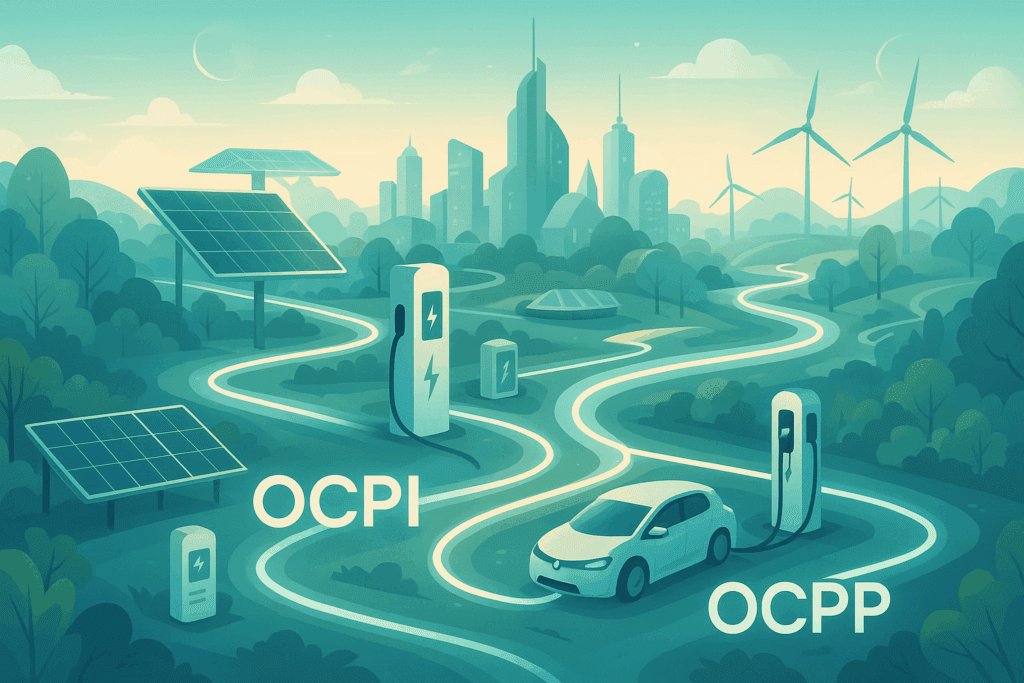
Futuristic landscape illustration of a smart city powered by solar panels, EVs, and wind turbines, with glowing paths labeled OCPI and OCPP representing energy and data flow.
The Power of Open Standards

Open standards offer numerous benefits for both operators and end-users:

  • Flexibility: Charging stations from different manufacturers can be easily integrated, reducing dependence on a single vendor.
  • Future-Proofing: Standardized communication protocols allow for updates and upgrades without the need for complete system replacements.
  • Cost Savings: Reduced reliance on specific vendors leads to more competitive pricing and lower operational costs.
OCPP: The Backbone of Charging Station Communication

OCPP is designed to provide a uniform method of communication between charging stations and central systems, regardless of the manufacturer. The latest version, OCPP 2.0.1, makes it anable to introduce advanced features such as:

  • Plug & Charge (ISO 15118): Enables automatic authentication and payment as soon as an EV is connected, eliminating the need for cards or apps.
  • Enhanced Security: Built-in security protocols protect against cyber threats.
  • Device Management: Simplifies the installation, configuration, and maintenance of charging stations, including support for remote firmware updates.
  • User Interface: Supports multilingual displays and provides real-time information to users, enhancing accessibility and user-friendliness.

These new features not only improve the user experience but also simplify operations and increase efficiency for charging network operators.

OCPI: Seamless Roaming and Data Exchange

OCPI facilitates data exchange between e-Mobility Service Providers (eMSPs) and Charge Point Operators (CPOs), granting EV drivers access to a wide network of charging stations. The recent version, OCPI 2.3.0, introduces:

  • EU AFIR Compliance: Meets the requirements for data exchange with national access points.
  • Extensibility: Offers possibilities for custom extensions, allowing market participants to implement specific functionalities that align with their business models.
  • Direct Payment Module: Enables direct payments without the involvement of an eMSP.
  • These enhancements lead to a better charging experience for both operators and users.
EVesto’s Commitment to Open Standards

At EVesto, we strongly believe in the power of open standards. Therefore:

  • We fully support OCPP 1.6 and largely support 2.0.1, ensuring our customers benefit from the latest functionalities.
  • We are prepared for the implementation of OCPI 2.3, enabling seamless roaming and data exchange.
  • We actively share our knowledge and experience within the industry to promote the adoption of open standards.

By building on open standards, we ensure our customers are not tied to outdated technology and are always ready for the future.

The Future of EV Charging Infrastructure

The adoption of open standards like OCPP and OCPI is essential for the continued growth and development of EV charging infrastructure. They provide the flexibility and scalability needed to meet the increasing demand for electric mobility.

Curious about how EVesto can future-proof your charging infrastructure? We are happy to inform you about the possibilities through a clear demo.


Optimizing EV Charging Costs with Dynamic Pricing

Cut Expenses & Boost Sustainability

The introduction of dynamic pricing is set to transform the electric vehicle charging landscape. EVesto is at the forefront of this innovation, leveraging strategic tools to sync charging activities with real-time energy rates. This blog delves into how dynamic pricing can dramatically transform the EV charging landscape, offering significant advantages to Charge Point Operators (CPOs) and EV drivers.

Understanding Dynamic Pricing for EVs
Dynamic pricing for EVs enables users to adjust charging costs based on the hourly fluctuations in energy prices. Using predictive data that forecasts energy costs 24 hours in advance, EVesto empowers smart charging strategies that optimize cost and energy usage during the cheapest and least congested times.

The Technical Backbone of Dynamic Pricing
Dynamic pricing for EV charging might sound complex. Still, it essentially boils down to a smart system that adjusts the price of EV charging based on when electricity is cheapest and most plentiful. Here’s how it works, step by step:

1. Real-Time Energy Rates:
In dynamic pricing for EV charging, we utilize a “day-ahead” pricing model, where electricity costs for each hour of the next day are known in advance, sourced from the ENTSO-E Transparency Platform. This system enables EV charging to be planned during cheaper times, typically at night or when renewable energy production is high. By automatically adjusting charging rates based on these forecasts, dynamic pricing ensures users benefit from lower costs and supports increased use of renewable energy, all without requiring manual monitoring.

2. Predictive Algorithms:

  • These are like weather forecasts but for electricity prices. They use past data to predict when electricity will be cheap or expensive in the next 24 hours.
  • For example, you might decide to picnic when it’s sunny, but this system determines the best time to charge EVs when electricity prices are low.

3. Integration with EV Chargers:

  • Dynamic pricing is communicated to EV charging stations through an automated system. Here’s a streamlined overview:
  • Dynamic Tariff Notification: We inform all Mobility Service Providers (MSPs) via the Open Charge Point Interface (OCPI) daily about the next day’s hourly tariffs. This ensures everyone is prepared for the changes in charging costs.
  • Charging Session Calculation: Our system calculates the cost of each charging session using the provided tariff data. Charge Point Operators (CPOs) can adjust prices by adding a markup or setting a minimum price to ensure profitability.
  • Automated Scheduling: While we don’t currently offer scheduling capabilities, the system to do this must be an EMS or some other intelligent system or MSP solution like Deftpower. Nevertheless, our system optimizes EV charging for the lowest electricity prices. This process is fully automated, requiring no EV driver intervention.

4. Smart Charging:

Automated Charging Control: We ensure that tariffs are effectively communicated to MSPs or other relevant parties via the OCPI. This empowers MSPs to remotely initiate or terminate charging sessions based on the tariff data received. While OCPI facilitates such control actions irrespective of the tariff type, MSPs can utilize the tariff information to make informed decisions on when to commence or cease charging sessions, a functionality that aligns with the principles of smart charging. Energy Management Systems (EMS) may also leverage this tariff data for similar purposes.

  • Optimized Charging: Our system ensures that your car charges when electricity is cleanest and cheapest, aligning with the principles of smart charging. This automated process not only saves you money but also contributes to a greener planet by minimizing the carbon footprint associated with charging.
  • User Interface: CPOs can configure dynamic tariffs, set them on chargers or groups of chargers using batch operations, and review the type of tariff applicable during each session or Charge Detail Record (CDR). While managing the charging schedule is typically the task of MSPs, every CPO can access their own data. Thus, in the future, CPOs may be able to examine how a session looks and how pricing is compiled based on dynamic prices. The dashboard empowers CPOs with valuable information while leaving the control of scheduling and session management to the relevant parties.
  • Economic Benefits of Dynamic Pricing
  • Dynamic pricing provides more than just reduced electricity costs. For CPOs utilizing EVesto’s platform, it optimizes infrastructure utilization by incentivizing charging during off-peak periods, thereby balancing the load on the grid. It translates into direct savings for EV drivers, making EV ownership more economically attractive.

Dynamic Pricing Implementation at EVesto
EVesto is actively developing dynamic pricing capabilities through its advanced API technology. Ongoing development of OCPI code aims to broaden the accessibility and functionality of this feature.

The Shift Towards Flexible Charging: Dynamic vs. Static
Unlike static charging, where fees are fixed regardless of the time or energy demand, dynamic charging adjusts fees based on actual usage and grid conditions. This flexibility is key to managing energy flows more effectively, especially as the number of EVs on the road grows.

With its pioneering approach to dynamic pricing, EVesto is charting a path toward a future where electric mobility thrives economically and environmentally. This innovative strategy boosts cost efficiencies and enhances grid harmony by incentivizing charging during off-peak hours. As the electric vehicle industry evolves, adopting technologies like dynamic pricing is becoming essential. These advancements are pivotal in reaching broader energy management goals and ensuring the economic sustainability of EV charging infrastructures.

Embracing Transparency: Evesto’s Unparalleled Uptime and Real-Time Updates

Embracing Transparency: Evesto's Unparalleled Uptime and Real-Time Updates

In the ever-evolving world of technology, reliability and transparency are two vital factors users seek when entrusting their operations to a service provider. EVesto, a leading player in the EV industry, stands at the forefront by boasting an unprecedented uptime of over 99.9%.

At EVesto, transparency is not just a buzzword but ingrained in their core values. Recognizing the significance of instilling utmost confidence in its clients, the company provides real-time updates on its system’s performance. This commitment ensures that users remain well-informed and can witness firsthand the smooth operations powering their businesses.

Exploring Common Factors that Can Take an Electric Vehicle (EV) Charger Offline
In an industry where any downtime can drastically affect operations, EVesto’s commitment towards achieving unparalleled uptime begins with a thorough understanding of what could cause an electric vehicle (EV) charger to go offline. These include power outages, internet connection issues, hardware malfunction, software issues, lost connectivity with the backend system, overloading or overheating, electrical interference, poor maintenance, adverse weather conditions, vandalism or theft, and installation errors. Among these, issues arising from Charge Point Management Systems (CPMS) hold a crucial part.

Charge Point Management Systems can face several issues which might lead to an EV charger going offline, such as software bugs, communication issues, data overload, poor integration with other systems, inadequate security, firmware updates, configuration errors, and hardware failure. EVesto, aware of these potential problems, employs a comprehensive approach to mitigate these risks, ensuring their CPMS is robust and reliable.

Transparency in Action
To exemplify their transparency, EVesto extends an open invitation to all users to check the status of their Charge Point Management System (CPMS) independently. By visiting https://status.evesto.com/,clients can witness the unwavering commitment of EVesto to maintaining a robust and reliable platform. This proactive transparency extends to constantly monitoring the central hub offering the connectivity to chargers, the API, our portal, and crucial interoperability platforms such as e-clearing, P2P roaming connections, Gireve, and Hubject. By promoting transparency, EVesto aims to establish a strong foundation of trust and accountability with its valued users.

How is uptime calculated?
Regarding the uptime of EV chargers, Tesla’s Supercharger network, for example, had an average uptime of 99.95% in 2022, considered near perfect. However, the measure of “uptime” can be complex as it depends on the methodology used. For instance, Tesla defines the uptime of Supercharger sites as the average percentage of sites globally that had at least 50% of their daily capacity functional for the year.

At EVesto, the uptime of the charger is defined as the period during which a charger maintains a steady connection to the EVesto network. This means it is up and operating optimally if the charger is connected without hardware or charger-related complications. This approach enables EVesto to provide reliable uptime statistics, assuring clients that when their charger is connected to EVesto, they can anticipate a seamless charging experience.

In the world of EV charging, despite the high uptime, occasional outages are an inevitable part of the landscape. Traditional steps when encountering a broken EV charger involve:

Enhancing Customer Experience Through Proactive Solutions
However, with EVesto CPMS, the response to such issues transcends the ordinary. Thanks to the introduction of Connectivity and BootNotification webhooks, EVesto empowers its clients with innovative solutions to address uptime-related issues. These unique tools grant immediate access to critical information about device status, allowing users to make informed, data-driven decisions and enhance their charging operations like never before.

Here’s where the real game-changer comes in: the ability to detect a charger’s offline status. In many scenarios, it’s often too late to undertake corrective measures once a charger goes offline. However, with EVesto’s innovative offline webhook, clients are informed when the charger goes offline in real-time. This newfound knowledge enables the client to act promptly by dispatching a technician or manually restarting the charger on-site.

By leveraging these enhanced webhooks, EVesto clients can proactively identify and resolve connectivity issues. This proactive approach ensures uninterrupted charging sessions and maintains the highest level of operational efficiency. Through providing instant updates about device status, clients are empowered to take timely actions, minimizing downtime and maximizing the performance of their charging infrastructure. It’s not just about handling issues; it’s about turning challenges into opportunities for enhancing service delivery.

By setting remarkable standards for uptime and promoting transparency through real-time updates and independent verification, EVesto differentiates itself in the technology landscape. EVesto’s dedication to smooth operations and user confidence remains steadfast, solidifying its reputation as a trusted partner in today’s fast-paced digital world. EVesto’s innovative Charge Point Management Software offers a reliable solution for Charge Point Operators and B2B clients in electric mobility. Learn more about our products and services here.

Understanding the Open Charge Point Protocol (OCPP): From 1.6 to 2.0.1

Understanding the Open Charge Point Protocol (OCPP): From 1.6 to 2.0.1

As the electric vehicle (EV) industry continues to grow, the protocols governing EV charging have evolved to meet the changing needs of the market. One such protocol is the Open Charge Point Protocol (OCPP), a network protocol that enables seamless communication between EV charging stations and a Charge Point Management System (CPMS).

OCPP 1.6: Laying the Foundation

OCPP 1.6, an earlier version of the protocol, established a solid foundation for communication between charging stations and the CPMS. It defined various types of messages for exchange, outlined error-handling procedures, and described operations that could be performed using the protocol. Importantly, it also provided for offline behaviour, allowing charging points to operate stand-alone in the event of the unavailability of communications or the CPMS.

OCPP 2.0.1: The Latest Evolution

Fast forward to OCPP 2.0.1, the latest version. The transition to 2.0.1 from 1.6 represents a major version bump, indicating that it introduces breaking changes. This version introduces several new features and improvements:

  • ISO 15118 Support: This allows for features like Plug and Charge (PnC), which enables the EV to authenticate and authorize a charging session upon plugging into the station.
  • Improved Security: Enhanced security features include using Transport Layer Security (TLS) for secure communication and introducing security events and security profiles.
  • Smart Charging: More advanced smart charging capabilities can help manage the load on the electrical grid by adjusting charging speed or timing.
  • Display Messages: The central system can send messages to be displayed on the charging station, useful for user instructions, promotional content, or other information.
  • More Granular Transaction Data: Detailed transaction data can be useful for billing, analysis, and troubleshooting.
  • Device Model and EVSE Management: New messages for managing device models and Electric Vehicle Supply Equipment (EVSE) have been introduced.

OCPP Compatibility and Backward Compatibility

OCPP compatibility refers to a charging station’s ability to communicate with a CPMS using the OCPP. A charging station is considered OCPP-compatible if it can successfully send and receive messages defined by the OCPP to and from a CPMS.

As for backward compatibility, OCPP 2.0.1 is not backwards compatible with OCPP 1.6. This means a CPMS using OCPP 2.0.1 cannot communicate with a charging station using OCPP 1.6 and vice versa.

OCPP vs OCPI

While OCPP governs communication between the charging station and the CPMS, the Open Charge Point Interface (OCPI) is another protocol that allows different CPMSs to exchange information. This can include information about charging station locations, availability, tariffs, and facilitating roaming services for EV drivers.

OCPP 1.6 vs 2.0.1

The main differences between OCPP 1.6 and 2.0.1 lie in the new features and improvements introduced in 2.0.1, as outlined above. These enhancements in security, smart charging, and other areas represent significant advancements in the protocol.

EVesto and OCPP

The core foundation of EVesto is built around standard protocols such as OCPP, OCPI, and OICP. At the heart of the EVesto platform lies the connectivity layer – the software that facilitates the connection of chargers with EVesto. Once this connection is established, a dialogue in the form of OCPP messages is initiated between the charger and EVesto. This exchange forms a crucial part of the EVesto platform and serves as the starting point for all the features it offers.

The technical protocol OCPP and the data it encompasses are enriched and modified within the platform, forming the basis for further communications with external systems, particularly in roaming. The OCPI and OICP protocols, designed to enable a seamless charging experience for EV drivers across different charging networks, function as a bridge between e-Mobility Service Providers (EMPs) and Charging Point Operators (CPOs). At its core, EVesto supports these protocols and incorporates algorithms that bridge the gap between the low-level OCPP protocol and the roaming protocols OCPI and OICP.

EVesto and OCPP 2.0.1

In an exciting development, EVesto has already implemented a subset of OCPP 2.0.1. Their initial support for OCPP 2.0.1 covers processes comparable to what OCPP 1.6 offers, marking a significant step forward in EVesto’s service offerings. EVesto is inviting its partners to begin experimenting with this new implementation. Additionally, EVesto has recently joined the Open Charge Alliance (OCA), further solidifying their commitment to advancing EV charging standards and protocols.

Understanding OCPP is essential for anyone involved in the EV charging ecosystem. The evolution of the Open Charge Point Protocol (OCPP) from 1.6 to 2.0.1 marks a significant advancement in the electric vehicle (EV) industry, adapting to the changing needs of the market. Companies like EVesto are leading the way, integrating these protocols into their platforms to enhance the EV charging experience. With their recent implementation of a subset of OCPP 2.0.1 and membership in the Open Charge Alliance (OCA), EVesto underscores the importance of these protocols in driving the development of the EV charging ecosystem. As we look to the future, these protocols will continue to shape the landscape of EV charging.

Dive deeper into the world of EV charging protocols.

Key Protocols that govern Electric vehicle (EV) charging

Key Protocols that govern Electric vehicle (EV) charging

Protocols are crucial for effective communication in the electric vehicle (EV) charging ecosystem. They ensure interoperability, standardization, and secure communication between various components. This article explores the significance of protocols and how EVesto utilizes them to deliver seamless and efficient charging solutions.

The Importance of Protocols in EV Charging

Protocols play a vital role in the operation of EVs and their charging infrastructure. They enable interoperability, ensuring effective communication between devices, systems, and networks. Protocols also provide a framework for standardization, guaranteeing compatibility between EVs, charging stations, and management systems from various manufacturers. Additionally, they define the implementation of functions and features, such as remote control and firmware updates.

Moreover, protocols incorporate security features to protect against unauthorized access and malicious attacks, ensuring the integrity of the charging process and user data. They also enhance the user experience by enabling roaming services and simplifying EV charging.

Here are some of the most important ones:

  1. Open Charge Point Protocol (OCPP): This is a universal protocol for communication between charging stations and a central management system. It allows for remote control, firmware updates, session information, and more. There are several versions of OCPP, with 2.0.1 being the latest.
  2. IEC 61851 is an international standard for electric vehicle conductive charging systems. It defines the communication between the EV and the charging station for AC charging.
  3. ISO 15118: This international standard defines the communication between the EV and the charging station. It supports advanced features like Plug and Charge (PnC) and bi-directional charging (V2G).
  4. CHAdeMO: This is a DC charging standard that was developed in Japan. It supports both fast charging and bi-directional charging.
  5. Combined Charging System (CCS): This is a standard for DC fast charging developed by several major automobile manufacturers. It combines the AC and DC fast charging connectors into a single port on the vehicle.
  6. Tesla Supercharger: This is a proprietary DC fast charging protocol developed by Tesla. It is currently only compatible with Tesla vehicles.
  7. Open Charge Point Interface (OCPI): This protocol allows roaming services between different charging station networks. It enables EV drivers to use charging stations from different operators with a single subscription.
  8. OpenADR (Automated Demand Response): This is a standard for communication between utilities and customers to adjust power demand. It can be used in EV charging to shift charging times to periods of low electricity demand.
  9. The Open InterCharge Protocol (OICP): is a protocol developed by Hubject, a joint venture of several major companies, including BMW, Bosch, Daimler, and others. It was created to facilitate the interoperability of charging infrastructure and services for electric vehicles (EVs).OICP is primarily used in Europe and allows for the exchange of information between different charging station operators and e-mobility service providers.
  10. The eMobility Interoperation Protocol (eMIP): is an open protocol developed by GIREVE. It enables the transfer of data and services between an operator’s software platform and GIREVE’s platform. The protocol aims to enable roaming of charging services and provide access to a comprehensive charging point database.
  11. The Open Smart Charging Protocol (OSCP): is an open standard for communication between EV charging stations, management systems, and smart grid components, enabling smart charging, demand response, and grid integration.
  12. The Open Clearing House Protocol (OCHP): is an open standard for EV charging networks. It enables seamless roaming and billing between different charging operators. OCHP allows EV drivers to access stations from multiple operators using a single authentication and payment method.
  13. SAE J3400 Standard: This is a significant new development, representing a milestone for Tesla-developed connectors used in EV charging. The SAE J3400 standard marks a step towards defining the design, construction, and technical characteristics of the connectors and inlets used in EV charging. It aims to expand charging access for current and future EV drivers by moving the North American Charging Standard (NACS) connector towards an open industry standard. This initiative is expected to enhance interoperability and streamline the charging experience for EV drivers.
  14. NACS – North American Charging Standard: Introduced by Tesla and now adopted as NACS, this standard offers AC and DC charging capabilities in a single plug, with capacities exceeding those of the CCS standard. Major automakers, including Ford and General Motors, have announced plans to adopt NACS, indicating its significant impact on the industry. Vehicles compatible with NACS are anticipated to start rolling out in 2025, with adapters available for use in the meantime.

Protocols and standards specific to Europe for electric vehicle (EV) charging
There are a few other protocols specific to Europe that are next to the above-mentioned protocols.

  • IEC 62196: This is an international standard, but it’s particularly relevant in Europe. It defines the physical connectors used in EV charging. Type 2 connectors, specified in this standard, are the most common connectors used for EV charging in Europe.
  • IEC 61851-1: This standard is used worldwide but is very important in Europe. It defines the conductive charging system between the electric vehicle supply equipment (EVSE) and the EV, including the control functions and digital communication.
  • IEC 61851-23, -24: These standards define DC charging and the digital communication between the EV and the EVSE for DC charging.
  • EN 50604: This European standard defines safety requirements for exchangeable lithium batteries in light EVs.
  • EN 50498: This European standard applies to devices installed in EVs intended for driver interaction. It includes requirements for the user interface of EV charging stations.
  • European Directive 2014/94/EU: This directive sets out the minimum requirements for deploying alternative fuel infrastructure across Europe, including EV charging stations. It promotes the use of common standards and interoperability to facilitate the growth of EV charging infrastructure.

EVesto Leveraging Protocols for an Enhanced Charging Experience
EVesto recognizes the significance of protocols in delivering an enhanced charging experience. The platform’s core foundation is built around standard protocols such as Open Charge Point Protocol (OCPP), Open Charge Point Interface (OCPI), and Open InterCharge Protocol (OICP).

EVesto’s connectivity layer, powered by OCPP, establishes seamless communication between chargers and EVesto’s central management system. This enables remote control, firmware updates, and session information, ensuring efficient charging processes. Additionally, EVesto’s Charge Point Management System (CPMS) supports ISO 15118, allowing advanced features like Plug and Charge (PnC).

The platform also leverages OICP to facilitate interoperability and information exchange with other charging infrastructure providers, enhancing the availability and accessibility of charging stations.

Protocols are essential in the EV charging ecosystem, ensuring compatibility, standardization, and secure communication. EVesto understands the importance of protocols and utilizes them to deliver an enhanced charging experience. By implementing industry-standard protocols such as OCPP, ISO 15118, and OICP, EVesto enables effective communication, advanced features, and interoperability. As the EV industry evolves, protocols will continue to drive innovation and shape the future of electric vehicle charging.

Exploring EVesto’s Strategy for Secret Rotation

Exploring EVesto's Strategy for Secret Rotation

As the adoption of electric vehicle (EV) chargers continues to surge, it’s crucial to recognize the escalating security risks associated with these devices. Numerous studies highlight the potential threats of using chargers without passwords or relying on unsecured HTTP connections. Thankfully, the potential for charger firmware to mitigate these risks is high and largely depends on Charge Point Management System (CPMS) capabilities. EVesto, developed using the ‘security by design’ principle, is here to transform the landscape.

The ‘Security by Design’ Principle

In essence, this principle means that security best practices are integral at every stage of development, right from the conception of the idea to its operational phase. The ‘security by design’ approach is embedded in the software code and extends to supporting security features for EV chargers.

bOne such feature is ‘rotating secrets,’ a prevalent practice in software development and cloud services. This procedure involves maintaining two secrets – let’s term them Secret A and Secret B. Initially, the device gets configured with Secret A. When the secret is due for a change or compromised, the device switches to Secret B. Secret A can then be safely discarded and regenerated, completing a full cycle of secret rotation.

EVesto’s Strategy for Secret Rotation

When an EV charger is onboarded on the EVesto platform, it receives two secrets – Secret A and Secret B. Initially, the charger gets provisioned with Secret A. Most chargers support the OCPP security profile 2, defined by the Open Charge Alliance in ‘Improved Security for OCPP 1.6-J,’ which enables the ChangeConfiguration command. From the EVesto portal, the new secret is provisioned using this command, followed by a Reset. Once the charger reconnects, Secret A can be rotated within the portal, enhancing the security of the charger.

Automating Secret Rotation: The Next Step

While this is a critical first step towards increasing security capabilities on the EVesto platform, the subsequent phase would be automating the secret rotation. This step could significantly enhance the security level of your CPMS connection. With several new features in the pipeline, we’re excited about the transformative potential that EVesto brings to the charger security space. Stay tuned as we share more updates and innovations in the coming weeks.

As EV chargers become integral to our everyday lives, ensuring their security is paramount. With innovative solutions like EVesto, developed using the ‘security by design’ principle and advanced features such as secret rotation, we can navigate these challenges and secure a safer, smarter future for EV charging.

Green Bytes & Electric Sites: Green Computing in EV Charging

Green Bytes & Electric Sites: Green Computing in EV Charging

As the world pivots towards sustainable energy solutions, green computing has gained significant momentum, especially in sectors like electric mobility. Green computing, a term first coined in the early 1990s, represents a conscious effort to reduce environmental impact through more efficient and less wasteful use of computing resources.

History and Evolution

The journey of green computing began as an initiative to improve energy efficiency in data centres and computing ecosystems. Over the years, it has evolved to encompass a broader range of practices to minimize the environmental footprint of computing operations and data storage. This evolution mirrors the growing global emphasis on sustainability, driven by the increasing awareness of climate change and environmental degradation.

Defining Green Computing

At its core, green computing involves developing and using computer resources in an environmentally sustainable manner. This includes the design, manufacturing, and disposal of computing hardware and the algorithms, systems, software, and applications that drive them. It’s about creating systems that are not only energy-efficient but also economically viable and socially responsible. Green Computing can be dissected into several strategies.

Green Computing Strategies

  1. Energy-Efficient Hardware:
    Use of low-power consumption devices and energy-efficient servers and components.
  2. Virtualization:
    Running multiple virtual machines on a single physical machine to maximize resource utilization.
  3. Cloud Computing:
    Leveraging cloud services to reduce the need for on-premises servers, thus saving energy and reducing hardware waste.
  4. Data Center Optimization:
    Improving cooling systems, using renewable energy sources, and implementing power management techniques in data centres.
  5. Resource Allocation Algorithms:
    Employing algorithms that dynamically allocate resources only when needed, minimizing idle time.
  6. E-Waste Management:Ensuring proper recycling and disposal of outdated or broken electronic equipment.
  7. Remote Work and Teleconferencing:
    Reducing the need for physical travel and office space decreases energy use and carbon emissions.
  8. Green Software Engineering:
    Developing software that is resource-efficient and that can run on less powerful machines.
  9. Paperless Processes:
    Digitizing workflows to reduce the need for printing and paper usage.
  10. Sustainable IT Procurement:
    Purchasing from suppliers who demonstrate environmentally responsible practices.

Green Computing in CPMS: An In-Depth Look

As we navigate the nuances of electric mobility, the spotlight often falls on Charge Point Management systems (CPMS) as the operational backbone. Yet, the green computing principles behind these systems truly propel the industry forward. EVesto’s CPMS emerges as a paragon in this domain, merging technical prowess with ecological sensitivity.

Energy-Efficient Design and Cloud Ingenuity

At the forefront of our strategy is the energy-efficient design of our software. By creating systems that demand less computational power, we significantly reduce the energy needs of our servers, exemplified by our Azure data centre operations. Our reliance on cloud-based solutions compounds this efficiency. Opting for the cloud over traditional on-premises setups cuts down energy consumption and embodies our dedication to reducing electronic waste as the need for constant hardware upgrades dissipates.

Data Optimization: A Pillar of Sustainability

Data is the lifeblood of CPMS, and its management is where green computing really shines. Through data compression and optimized storage, EVesto ensures less energy is expended in data processing, leading to a leaner, greener operation. This focus on data optimization is not just an operational choice; it’s an environmental stance, ensuring that every byte of data serves a purpose without excess cost or carbon.

Scaling Smartly: The EVesto Advantage

The true measure of our commitment to green computing is evident in how we scale. EVesto’s platform is designed to support an ever-growing charging station network without linear resource use or cost increases. This scalability is a strategic choice, reflecting our understanding that resource efficiency isn’t just about what we use and how we grow.

Quantifying Our Green Impact

As part of our ongoing mission, we are committed to quantifying the CO2 savings delivered through our platform. By providing transparent metrics, we not only showcase the efficiency of EVesto but also support our customers in their sustainability journey, making the environmental benefits of our platform clear and compelling.

Benefits of Green Computing

Minimising computational costs has become more important with a growing shift towards cloud infrastructure. We aim to continuously reduce our footprint by implementing green computing principles. To conclude, we summarise the main benefits of green computing.

  1. Cost Efficiency: Green computing practices often result in significant cost savings. By optimizing software to use less computational power, companies can reduce energy consumption and lower operating expenses, translating into more competitive pricing for customers and higher margins.
  2. Scalability: As demonstrated by EVesto, a focus on green computing allows for a scalable infrastructure that can support a growing number of EV chargers without significant additional costs. Efficient use of cloud resources ensures that the platform can expand its capabilities without a corresponding increase in resource consumption or expenses.
  3. Sustainability: Green computing aligns with global sustainability goals by reducing the carbon footprint of computing operations. For EVesto, this means contributing positively to the environment by minimizing energy usage and electronic waste, which resonates with the core
  4. Market Differentiation: Embracing green computing can differentiate companies from competitors by showcasing a commitment to innovation and environmental responsibility. This can attract customers who prioritize sustainability, thus opening up new market segments and opportunities.
  5. Enhanced Reputation: AAs public awareness of environmental issues grows, companies that adopt green computing can enhance their brand image. For companies, this translates into an improved reputation as a forward-thinking, responsible business, which can lead to increased customer loyalty and trust.
  6. Regulatory Compliance: With increasing regulations to reduce environmental impact, green computing practices can help ensure compliance with these laws, avoiding penalties and enabling companies like EVesto to benefit from incentives or tax breaks associated with sustainable operations.
  7. Operational Resilience: Green computing strategies contribute to operational resilience by promoting using renewable energy sources and efficient data centres. This reduces the risk of operational disruptions due to energy shortages or fluctuating energy prices.
  8. Innovation and Continuous Improvement: Companies focusing on green computing are often at the forefront of technological innovation. For EVesto, this can lead to continuous improvements in our CPMS, ensuring that the platform remains cutting-edge and effective.
  9. Customer Transparency and Engagement: By quantifying and communicating the environmental benefits of our platform, EVesto can engage with customers on a deeper level, providing transparency and fostering a sense of partnership in achieving shared sustainability goals.
  10. Attracting Talent: A commitment to green computing can help attract top talent, particularly from the growing pool of professionals seeking to work for environmentally conscious organizations.

The advancement of green computing within the electric mobility sector reflects a collective stride towards a more sustainable future. It’s a commitment that transcends individual companies and becomes a shared goal across the industry. By streamlining energy use, optimizing resources, and continuously innovating, the field addresses the immediate needs of electric vehicle charging and contributes to the global effort to mitigate environmental impact. This journey of progress, powered by initiatives across various platforms, including cloud-based solutions and data optimization, is a testament to the potential of technology as a force for ecological stewardship and operational efficiency. The road ahead is bright with the promise of cleaner energy and smarter infrastructure, driving us all towards a greener horizon.

Are you ready to revolutionize your EV charging operations with green computing? Book a demo to drive efficiency in EV charging.

Harmonizing Electric Vehicles and Energy Systems

EVesto Partners with Webfleet

In a world swiftly pivoting towards electric vehicles (EVs), harmonizing EVs with our existing energy systems can’t be understated. As EV adoption surges, the onus falls on innovations within Smart Grid Technologies to ensure seamless integration. Charge point management software emerges as a critical player in addressing the multifaceted challenges that the integration of EVs into the power grid presents. There are several strategies and features that can be implemented in charge point management software to help tackle these issues.

The Impact of EVs on The Grid
The ascent of electric vehicles (EVs) heralds a new era of mobility but also presents challenges for our existing power grids. The surge in electricity demand due to EV charging can strain the grid, especially during peak hours. Moreover, the localized demand spikes can affect the distribution infrastructure, potentially leading to overloads and outages if managed properly. However, with smart grid technologies, these challenges can be transformed into opportunities.

How EVs and smart grid technologies interact:

  • Load Management: Smart charging mitigates grid overloading risks by scheduling charging during off-peak hours or redistributing the load.
  • Vehicle-to-Grid (V2G) Integration: EVs act as mobile energy storage, feeding energy back into the grid during high-demand periods and charging during low demand.
  • Renewable Energy Integration: EVs absorb excess renewable energy, aiding in the creation of a resilient and sustainable energy ecosystem.
  • Infrastructure Upgrades: The growing EV adoption necessitates more charging stations and distribution network enhancements
  • Data Analytics and Predictive Maintenance: Predictive analytics optimize charging schedules and forecast demand, bolstering grid stability and reliability.

These interactions between EVs and smart grid technologies are vital for transitioning to a sustainable and electrified transportation ecosystem, unlocking the full potential of EVs in harmony with the grid.

At EVesto, we not only empower our clients with actionable data for load balancing, smart charging, predictive analytics, and strategic infrastructure planning but also prioritize cybersecurity. We’re deeply committed to ensuring grid stability and protecting against cyber threats.

Deep dive into strategies and features that can be incorporated:

  • Demand Response Management:
  • Load Balancing: Implementing sophisticated algorithms to distribute the charging load evenly across the grid, averting overloads during peak hours.
  • Dynamic Pricing: In developing stages, dynamic pricing can incentivize off-peak charging by offering lower rates during low demand.
  • Integration with Renewable Energy Sources:
  • Green Charging: Prioritize charging from renewable energy sources to reduce the carbon footprint of EV charging.
  • Energy Storage Integration: Integrate with energy storage systems to store renewable energy for later use in charging.
  • Smart Charging:
  • Scheduled Charging: Allowing users to schedule their charging sessions during off-peak hours significantly reduces grid strain.
  • V2G (Vehicle-to-Grid) Integration: V2G capabilities enable EVs to feed energy back into the grid during high demand, promoting a bidirectional energy flow.
  • Predictive Analytics:
  • Forecasting: Harnessing data analytics to forecast demand patterns, aiding in the optimization of grid operations
  • Predictive Maintenance: Utilizing predictive algorithms, CPOs can anticipate and pre-empt issues before they occur, ensuring a smooth operation.
  • Infrastructure Planning:
  • Optimal Site Selection: Data analytics can spotlight optimal locations for new charging stations based on demand patterns and grid capacity, ensuring the infrastructure grows intelligently with the demand
  • Interoperability and Standardization:
  • Open Standards: Although yet to be fully realized, adopting open standards can ensure interoperability between charging networks and grid systems.
  • API Integration: Open APIs can facilitate integration with other systems, creating a cohesive ecosystem.
  • Remote Monitoring and Control:
  • Real-Time Monitoring: Real-time monitoring of charging stations can swiftly identify and address issues.
  • Remote Control: Enabling remote control of charging stations can manage load and avert grid instability.

Collaborating with innovative partners is key to moving towards Grid Harmony. Our partnership with Ampcontrol is a big part of this. The technical work we do together opens up many benefits for our customers, like lower energy costs and reliable charging, thanks to Ampcontrol’s smart charging and energy management software.

Here’s how this collaboration helps in achieving Grid Harmony:

  • Optimized Charging: Ampcontrol’s software smartly schedules charging times, avoiding high energy use during peak hours, which lowers costs for our customers.
  • Peak Demand Shaving: The software helps avoid energy use during peak times, which is good for the grid and EV owners. This reduces grid stress and lowers energy bills.
  • Better Energy Management: Ampcontrol’s energy management aligns well with EVesto’s goal of a sustainable and reliable energy system. This helps tackle the challenges of integrating EVs into the grid.
  • Data-Driven Insights: Combining data from both platforms helps in planning and making sure the charging system grows well with the increasing EV market.
  • Benefits for Customers: This partnership offers customers a strong, cost-effective, and reliable charging solution, making EV charging easy and beneficial.

Also, as we use more data, EVesto’s strong security measures protect against cyber threats. Our blog post discusses our strong focus on EV charger security and keeping data safe.

Working with Ampcontrol and other EMS solutions brings us closer to a future where smart grid tech and electric vehicles blend well, creating a balanced, sustainable energy setup. This partnership not only tackles current challenges but also sets a solid base for the promising path ahead in EV space, making it easier for our customers to move towards grid harmony.

At EVesto, we are at the forefront of delving into and implementing smart grid technologies to weave a harmonious interaction between EVs and the power grid. Our relentless efforts in advancing charge point management software mirror our unwavering commitment to nurturing a sustainable and reliable energy ecosystem. The path towards Grid Harmony is spread with challenges and opportunities, and we at EVesto are steadfast in our resolve to navigate through them, carving out a greener future for all.

This blog highlights how EVs affect the grid and how smart grid technologies, driven by innovative strategies, play a key role in creating a smooth connection between the grid and EVs. As we move forward, combining these technologies will help overcome challenges and lay the groundwork for a more sustainable and electrified transportation future.